Not exactly news that I'm a hug fan of Joseph Sheridan LeFanu's Carmilla. Well, now I've written a play version and we're trying to put it up on stage!
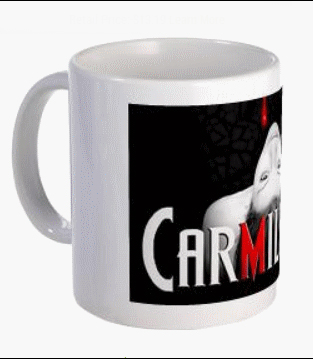
In fact we've got rather a lot lined up. Enough to run a fundraising campaign to finish the process, complete with gifts (like this mug) for certain levels of donors.
This really is a dream come true for me, seeing LeFanu's classic as I've long believed it should be--with all the ambiguity, the drama, the sensuality and haunting as the original story!
Given we're talking about a stage play and not a novella, more a story being told in 2013 instead of 1872, some changes are of course needed. Probably the biggest change I've made is to create a character to whom Laura is telling her history. LeFanu has her talking to someone. We don't know who, not really. In my version, this is a specific person with an agenda of their own--an agenda somewhat at cross purposes with Laura, which leads to awkward questions Laura probably does not like answering. But must, given the circumstances...
Showing posts with label LeFanu. Show all posts
Thursday, September 5, 2013
Wednesday, July 21, 2010
I am a Guest Blogger, Part Deux!
A post near and dear to my heart for Vampires.com--about Joseph Sheridan LeFau's Carmilla.
Sunday, March 28, 2010
Carmillas: "Blood and Roses" (Review)
Spoilers ahoy!Herein is the last in my series of reviews of filmed adaptations of Joseph Sheridan LeFanu's vampire classic Carmilla. Next up, Roger Vadim's 1960 motion picture Blood and Roses. Such was its English-language title. In French the movie was more usually known as Et mourir de plaisir ("To Die of Pleasure").
My feelings about this flick began and remain mixed. What cannot be denied is that it captures something interesting and emotionally real amid an air of fantasy blending with reality. Other critics have noted its mood, which manages to convey eroticism with virtually no sexuality. No small feat. And the tale is a compelling one--despite the fact I don't really like any of the characters (an overrated "requirement" in my opinion).
But it isn't really an adaptation of Carmilla at all. The t.v. shows House and Monk have more to do with Sherlock Holmes than this film to do with LeFanu's tale.
Relocating the story to modern-day Italy, Vadim begins with the family Karnstein. In this case, they are a still-extant noble house with branches in Italy and Austria (those who know European history should find this very easy to accept). Legend tells of peasants attacking the Karnsteins in the 1700s out of fear they were vampires (again, historically this make some sense) with only one survivor--the beautiful Millarca, saved by her lover and cousin Ludwig. But Ludwig proved unfaithful. He nearly married three times, but each of his fiancees died soon before the wedding.
So the tale is told by Carmilla, last remaining Austrian Karnstein who lives with her cousin Leopoldo in an Italian estate. All agree Carmilla resembles long-dead Millarca while Leopoldo looks like Ludwig. We can see where this is going, but in general the script eshews the flavor of cliches. A dream-like atmosphere descends as a costume party begins to celebrate Leopoldo's engagement to Georgia. The nearby ruins--including the tomb of long-dead Millarca--become the setting of an elaborate fireworks display. Fire and mist abound while revellers in capes and masks dance and gossip in the night. A drunken Carmilla--only too obviously in love with her cousin--appears in a costume identical to that in Millarca's portrait (amusingly, this frightens away a couple of school girls reciting a poem for the event). Later, she stares into her reflection in a pool while a voice from the ruins summons her. Millarca extends her power, brings her latter day doppelganger to the tomb, which opens at her touch. We don't see what happens next but the result seems clear. Millarca walks again, taking possession of Carmilla's body.
All this makes for a good movie, and in the hands of a fine director like Vadim, the results do more than entertain. They move. They even compell.
But...
This is not LeFanu's story. Instead of a strange and mysterious love affair between two girls, we have an immortal stalker of a handsome man at the apex of a romantic triangle. Instead of love or at least obsession between vampire and victim, we see a vampire pursuing her prey with little more feelings than a snake has for a bird. The slow pace of 19th century rural Styria gives way to modern Italy, amid coroner inquests and official inquiries and a stream of visitors to the Karnstein home. Elements of the original remain, but more as set pieces (effectively used).
Two other versions of Carmilla I know were filmed. One was a 1960s BBC production starring Jane Merrow, almost certainly lost. The other was for French television in the 1980s that I'm trying to get my hands on. Wish me luck! Another--rather lurid--version, complete with sword fights and copious female nudity, is supposed to be filming in Europe right now. When and if it is finished and released, expect a review from me. And if you know of any versions I've not mentioned, you'll earn much gratitude on my part for sharing!
Tuesday, February 23, 2010
Polish TV Carmilla (Review)
Spoilers ahoy!Here is the latest in my reviews of all known adaptations of LeFanu's vampire novella Carmilla. Again, for the sake of those who haven't read earlier posts, I'm restricting myself to recognizable versions of the original story. Thus a movie with a lesbian vampire in it named "Carmilla" doesn't count unless it is in some sense trying to tell LeFanu's tale.
In 1982 an adaptation aired on Polish T.V. How I got ahold of a copy is fairly convoluted, involving an estate sale and a third party. Frankly, I'd never even heard of this one and was excited to set eyes on such a thing. Unfortunately, it is entirely in Polish, a language I do not speak and there are no subtitles. Yet I know the story well and this was a remarkably faithful version. Following it proved not difficult.
The title character is played by Izabela Trojanowska, who certainly brings to it an air of otherworldliness and predatory charm. She's evidently mostly known as a pop
singer in Poland. I've learned little more about the production, sad to say.What I can say, having watched it, is this might be the single most faithful version yet made. It begins with the prologue missing from every other filmed Carmilla. Then we view Laura's household as it is when the events of the story proper begin. For once she does indeed have two governesses, the older and no-nonsense Madame Perradon along with the more elegant and imaginative Mademoiselle de la Fontaine. We actually see the dynamic between them and Laura as well as Laura's father. We get a sense, for example, of the class differences between them. More (in fact, vital) a sense of Laura's place here is only too clear. Lonely, saddled with (relatively mild) rules and subtle expectations in lieu of distractions or pleasures. She comes across as a waif, but not really an ingenue. More like a girl on the verge of womanhood with little or no idea what that means, obedient by habit almost to the point of invisibility.
One thing that impressed me about this was how much the story remained from her POV. More than once the fact people were keeping things from her became vivid
through the camera work. That their mysterious guest focuses nearly all her attention on Laura of course proves intoxicating. Carmilla's arrival matches that of the book, but handled with what clearly couldn't have been a large budget. No carriage accident on screen, but as staged there was no need. A nice touch were the servants accompanying Carmilla's "mother." Not only silent, each had a kerchief tying their jaws shut, precisely as undertakers treated the dead in the 19th century. Shades of Marley in A Christmas Carol.Also included was the Mountebank selling charms against the vampire, although he is freaked by Carmilla's presence and later is brought back to do a drunken scene in the local graveyard which substitutes for the whole Baron Vordenburg sequence. For the sake of plot, Laura's father seems to be merged with General Spielsdorf, allowing him to have the scene of "catching" the vampiress about to feed. Good stuff! The peasantry, coming to ask help of the Polish equivalent of country squire worked well, allowing a flashback to the legend of a vampire hunter in the past. Like I said, the elements of the novella remained largely intact.
Mostly, though, what pleased me was the atmosphere--like an odd ghost story--and the relationship between the two female leads. Although predatory, this Carmilla seemed to feel a little guilt as her friend weakened. Laura herself seemed so modest as to willingly hold on to whatever little pleasures she could find, hardly thinking to ask for more. As her only friend is hunted down and destroyed, she seems in shock. Certainly no one seems to think her deserving of much comfort. Protection, yes. Care, certainly. But that she might have had feelings for this woman never seems to enter into anyone's mind.
I'll confess frankly to a wish the relationship between the two had been more sensual, that Carmilla be a bit more tormented a la Ingrid Pitt in The Vampire Lovers. But
that is personal taste.Yet all this leads up to a startling little denoument. In the aftermath of the vampire's destruction, Laura's father and Mademoiselle de la Fontaine fall asleep late at night in the main room. Each is in a comfortable chair as the candles flicker and the fireplace glows. The door to Laura's bed room opens. The girl emerges, wearing only her long white nightgown and for the very first time her hair is completely undone, like a pale mane of some animal. She glides into the room, waking no one. Her eyes fix upon the exposed throat of her governess...
Overall I was very impressed by this version. Very impressed indeed. Now if I can only find some English subtitles!
Saturday, February 6, 2010
Carmillas: "Crypt of the Vampire" (Review)
Spoilers ahoy!In 1963 the movie Crypt of the Vampire got made, the first real attempt (as far as I've been able to learn) to capture on film Joseph Sheridan LeFanu's classic novella Carmilla. Yes, I know there was Vampyr which was supposed to be inspired by LeFanu, but while an extremely fine movie one wonders how anyone could call it an adaptation. Not one character from the original makes an appearance, nor particularly any incident. So this joint Italian-Spanish production counts as the first.
How is it? Well, a mixed bag overall. Despite the DVD cover, the entire film in fact is black and white, used to generally good effect. The castle itself turns out to be an odd blend of shadow and stark open spaces. Certainly the dream sequences work without resorting to special effects, just atmosphere and acting. Many shots are quite beautiful.
Christopher Lee portrays Count Ludwig Karnstein, concerned over his daughter Laura (right name for once) who has terrible nightmares and who may resemble a vampire witch from generations past. A curse involving Carmilla's vengeance seems to be working its way through the current Karnstein family, killing young women. Laura herself fears she may be responsible--an interesting notion explored as well as possible given the near-total lack of personality she otherwise demonstrates. Count Ludwig hires an historian (the seemingly obligatory young male love interest) to investigate. A carriage accident results in a sweet young woman named Lubya staying at the castle. Readers of the original will no doubt realize she is in fact Carmilla, but the film actually makes one doubt it. No small feat. Added to this mix is a deeply superstitious housekeeper, an old mountebank (a character usually erased in the adaptation), plus a maid who is also the Count's mistress.
Visually, the whole thing works, even when it is being just a tad ridiculous. The heraldry afficiodo in me recoils at a coat of arms that consists of a stylized letter "K" for example. The women's hair is non-period, but that is hardly surprising. Even period films with many times the budget of this one often get that detail wrong. The lead actress is lusciously beautiful but almost startlingly susceptible to suggestion. Frankly she seems rather a ninny of the first order. Someone suggests she looks like the long-dead Carmilla, and she believes it (in fact they look nothing alike). The hint of guilt is enough to provoke all kinds of nightmares (quite effective to behold). And the mysterious Lubya winds the girl round her little finger with seemingly no effort.
Lee gives his typical good performance. Parenthetically, let me bemoan this man's career rarely allowed him to show the full acting chops of which he was in fact capable. Take a look at him in Lord of the Rings, in the original The Wicker Man and in the biopic Jinnah to see what I mean. He's the only memorable performer in this film, although to be fair everyone else does a workmanlike job.
The reason for the title eventually gets explained, with an idea that actually has some interest to it. Seems while she's wandering around killing girls Carmilla is also asleep in her crypt, vulnerable to destruction. Among other things this allows us the suspense of Lubya threatening Laura up until the last moment.
But at its heart the central character is no longer an expatriate English girl living by herself amid haunted woods. She's a vapid ingenue aristocrat who needs a man to protect her. The story has nothing really of the English or the German about it, feeling Italian more than anything else (understandably enough). This even extends to the look of the castle--a stark, practical exterior baking in the sun, contrasted with lush furnishings amid black-as-midnight shadows within. The heroine's father is not elderly nor does he discount the supernatural.
I've seen worse adaptations (the first version of Moby Dick springs to mind). The movie has some charm. But at heart it is almost totally its own story rather than a genuine attempt to adapt LeFanu's famous tale.
Saturday, January 30, 2010
Carmillas: "Nightmare Classics" (Review)
Spoilers Ahoy!Second in my series of reviewing adaptations of the Joseph Sheridan LeFanu vampire classic Carmilla. A word of explanation--my goal remains to only review actual adaptations of the original. Movies or shows that simply use the names "Carmilla" or "Karnstein" do not count. Not for my purposes, anyway.
This time, 1989's edition of Nightmare Classics transporting the characters to the American antebellum South. Yet again Laura is given a name change, this time to Marie for some reason (played by Ione Skye) with Meg Tilly as the title character. A Van Helsing-stand-in named Inspector Amos is included but sans any personal stake in tales of vampires--quite unlike Baron Hartog of The Vampire Lovers or Baron Vordenburg of the novella. Rather Roddy McDowell's character is there to (rather surprisingly) piece together clues about what is going on with some explained deaths--including one from a swarm of bats!
One problem with adapting LeFanu's tale is the lack of obvious conflict involving our narrator/main character. In this one, tension between Marie and her father (Roy Dotrice) fills the void, at least partially from the fact Marie's mother deserted them both. Relations between them are chilly at best, with the girl's loneliness like vinegar on an old but unhealed wound. All too eagerly she leaps at the chance to have a friend, a real friend, and if that friend turns out to be a creature from beyond the grave--well, what of it? One of the most effective sequences in this version is when the two girls play in the night, Carmilla revealing some of her powers to a delighted Marie. Meanwhile Inspector Amos tells Marie's father about the supernatural danger
threatening this house and home. Which brings us to arguably the most startling and famous image of this version--Carmilla literally floating in the air as she feeds upon a willing Marie.As far as I know, this Carmilla is one of only two adaptations to end with the strong hint that the vampire hunters are too late, that while Carmilla herself is destroyed the titular heroine of the story has taken her place among the undead. Indeed, that is one of my favorite "bits" from this version. And honestly, both Skye and Tilly measure up to Doctrice in the acting department (the same cannot quite be said of McDowell, but he isn't bad by any means). Watching this film, one understands Marie's interest in her strange friend, while the interplay between father and daughter feels essentially real.
But the story just does not flow well at all. It feels rushed, and ultimately some of it seems stapled together rather than arising from the action. Odd details pop up, such as the notion that Carmilla was the one who took Marie's mother away, but nothing is really made of this. Nor does it make that much sense. I mean, if there was a whole tomb full of vampires wouldn't a whole lot more deaths be going on? And what about Marie's mother? What was she doing in that tomb? Not to mention (well, actually to mention it) exactly what Carmilla's plan at the end seemed to be.
I also have a pet peeve in vampire stories--namely, that piercing the heart should simply not be easy. That's why we have rib cages, after all.
Still, in this one the narrator was not some gormless little girl. She was a young woman with personality (albeit one nothing like Laura of the novella). And it is reassuring to see no obvious young male suitor--which in turn gives a tiny hint of (at least emotional) incest regarding her father. Juicy stuff! The stuff, to coin a phrase, of nightmares (hence the title). But it doesn't really come together. Methinks one reason is length. At a mere 51 minutes how can one do justice to this story? Especially while cramming it with gore and violence for no good reason?
Not an unworthy effort, but on the other hand not quite a successful one either.
Wednesday, January 27, 2010
Carmillas: "The Vampire Lovers" (Review)
Spoilers ahoy!This is a little project I've been considering for awhile--reviewing every single serious adaptation of Joseph Sheridan LeFanu's Carmilla, or at least the ones recorded. For the record, I will only review stage productions I've actually seen--which at present is zero but hopefully that will change.
In 1970 Hammer Studios looked back at a solid decade of success, remembered today with fondness by fans of genre film. They had more-or-less discovered Peter Cushing and Sir Christopher Lee (among others). Whereas Universal Studios' horror classics had been icons for generations, Hammer re-invented those same ideas with a distinctly British and more modern slant. Arguably their greatest success in this direction was Dracula. Lee at last supplanted Lugosi in many imaginations as the ultimate Dracula. Other vampire films followed, bringing fangs and bare bosoms as well as technicolor blood to the screen.
The Vampire Lovers marked a new mini-franchise for Hammer. Instead of linking the story (however slightly) to Bram Stoker's famous novel, instead they went after LeFanu's atmospheric tale of tortured love . Of course the lesbianism of the tale got maximum attention (or at least as much as they thought possible under the eyes of the censors), along with pleasantly copious amounts of partial nudity by lovelies such
as Ingrid Pitt and Madaline Smith. No complaints there! But they also did what one expects in a Hammer film...Extra blood, extra violence, extra sex. For example, this film has Carmilla physically seduce the heroine (re-named Emma for some reason) then do the same to her governess Madame Perradon (Kate O'Mara, later to achieve genre fame as The Rani on Doctor Who)! Far more was made of people suspecting a vampire might be in their midst, and Carmilla's response was to seduce/slaughter those who stood in her way. Along those lines, much more was made of the final "hunting" of her grave, intercutting those scenes with Emma's rescue by a suitably young male love interest (something totally absent in the original).
And yet...
Unlike almost any other version, this lurid (for its time) titillation feature captured an essence missing from virtually all other versions. Carmilla in this film is a tragic figure, one literally in tears as she is forced to feed, and broken-hearted at seeing Emma's reaction to the truth. Pitt is actually a bit old for the part, but she does a wonderful job of coming across as a someone in love rather than lust. Nor is that a function of the performance alone. We see the vampire prey upon another young woman (this one named Laura) without as much drama. Carmilla is so taken with Emma she tries to take her away, precisely where and to what end is not clear. Likewise Carmilla seems influenced/dominated by a strange man in black (a role initially offered Christopher Lee but he turned it down). Sexism? Perhaps. But the goal here pretty clearly remained to lend sympathy to the "monster" by making her not completely responsible for her actions. Likewise, before her beheading by Cushing's General Spielsdorf, Pitt's character seems almost to welcome it.
Hammer went on to make two other films more-or-less sequels or prequels to this one--Lust for a Vampire and then Twins of Evil. Pitt refused to reprise her role either time. Under pressure from censors, each film had less and less lesbian content. The supposed "love story" of the former was at least some attempt at capturing the chemistry Pitt and Smith clearly found. Alas, it didn't work. One other movie, Captain Kronos Vampire Hunter, had some tiny connection to the "Karnstein Trilogy" but nothing more.
So we are left with what should have been the trashiest version, but which in some ways was the most faithful.
Monday, December 21, 2009
Adapting Carmilla
(Note: This is a version of an essay I've written and published online before. However, there are several differences.)I like vampire stories. I also like adaptations, seeing how a story translates from one medium to another. But what I find intriguing as well as frustrating is the relative lack of adaptations of Carmilla. For those who don't know, this is a novella written by Joseph Sheridan LeFanu and generally agreed to be a classic of the vampire genre (if you're of a mind, the full text is right here). To my knowledge it has been filmed seriously three times--by Hammer Studios as The Vampire Lovers, by Roger Vadim as Blood and Roses and for Nightmare Classics using the original title. There was also Crypt of the Vampire which was reasonably faithful, at least in terms of general plot and had the added bonus of starring Christopher Lee. Three radio plays (one in German). Three known stage productions (one a chamber opera, another an erotic German musical). A pretty good version for Polish television. Another for French t.v. Still another (almost certainly lost) for the BBC in the 1960s (starring Jane Merrow).
And that is pretty much, as they say, it.
Now compare that to the dozens of plays, films, operas, musicals and ballets based upon Bram Stoker's novel! Just a role call of actors who' ve played the lead in straight adaptations make for an impressive list: Shreck, Lugosi, Villar, Lee, Palance, Oldman, Jourdain, Elliot, Langella, Warren, etc.
Why?
Methinks maybe I've figured it out.
Dracula has all kinds of mini-dramas going on, not least because the characters have full and interesting relationships. Lucy has three men proposing marriage to her, which everyone wants to keep the fatal illness of her mother secret. Mina's fiancee vanishes then reappears following a journey abroad. There's a madman, a shipwreck, an attempted murder, a detective story, a chase across Europe, etc.
Carmilla (written, it should noted, by someone who had not worked in the theatre) is a first person narrative. Its purported author is a lonely girl pretty in an isolated country estate. Other than the title character, she has no one her own age with whom to talk. We learn little or nothing about the lives and interests of those around her--her father, her governess, the housekeeper of the schloss (those two are nearly always combined into one character). The few other characters who do interact and at least have interesting stories to relate--General Spielsdorf, the mountebank, Baron Vordenburg--are little more than walk-ons. The other vampire victims are all off-stage. For that matter, there's only one vampire (Stoker's novel has five).Another problem is the nature of the vampirism itself, at least in this story. Laura (the narrator) recounts her dreams but they don't really suggest very much in terms of dramatic stage actions. She doesn't go sleepwalking, for instance. She doesn't seem to become in any way vampiric. More importantly, no one seems to suspect the truth for the longest time--until the General and Baron show up and events spiral to their conclusion with breakneck speed but little enough suspense.
LeFanu's creation has never been called an adventure, after all. Its strength lies in the
atmosphere, the mood and the subtle eroticism of events from the POV of someone who seems rather innocent, almost simple. Laura, quite simply, has not a trace of the spunk of Mina Murray or Lucy Westenra.All of which creates problems for the writer trying to adapt same. Not necessarily insurmountable problems, though. Nor should we forget just how many elements from Carmilla have found themselves into various depictions of Count Dracula and other undead. Most tellingly, this vampire gets to know and woo her victim -- ubiquitous now in the genre yet totally missing in Stoker's novel.
Most versions "solve" the issues by moving away from the source. Laura (whose name usually gets changed for some reason) nearly always gains a male admirer of an appropriate age. The business of discovering precisely what ails the heroine (or narrator) is strung out, with aforementioned male admirer taking part in some way. Some kind of tension ends up introduced between father and daughter -- or Laura's father is transformed into her cousin, sometimes to serve as a love interest. Along the way one of the two governesses nearly always vanish. Others become victims of the vampire, characters we get to know.
It occurs to me a more interesting direction is deeper into the text itself. For one thing, it is in the first person which makes it the testimony of a particular individual. So might Laura be a less reliable narrator than we suspect? What, in other words, did she leave out from the written word? Perhaps out of (justified?) fear that others would read her words? Indeed, she seems to be recounting the story to an older woman from a city. But who is this woman? And how did this account end up in the papers of an occult scholar (as noted at the very start of the novella)?
As written, Laura also seems isolated from the others in her home. One might ask "Why?" What were her father, governess and housekeeper keeping from her? For what reason? And what did they think would happen if she found out? Laura evidently was visited by the spirit of her dead mother--were there other signs of her being psychic? Hints abound in the novella that Laura's mother was in fact a distant relation of Carmilla herself. Does this have something to do with why she died? For that matter, what is an English gentleman doing living in a remote estate in rural Austria anyway? Her father also agreed to take a total stranger into his home with little or no argument, upon the word of a strange woman he claimed to have never met before. What was up with that?
Nearly every adaptation either turns Laura into a pretty nonentity or changes her personality to reflect a stronger character. One wonders is this is really necessary. True, making a waif into someone interesting remains a challenge, but again -- Laura is the narrator. She does not dwell upon herself in any great detail. Methinks maybe we should recall that the novella was written long before the ready availability of dramatic media -- plays were rare, and movies unknown. The written word in practice must have received far more attention (which certainly helps explain those compound, complex sentences). Hence tiny details within the text abound to give an image of Laura's actual personality:
She has grown up speaking a polygot of English, German and French which she openly believes most could not follow. What a fascinating detail! Both isolating and yet ennobling. She is apparently quite as obsessed with Carmilla as the vampire is with her. Imagine two girls spending hours brushing each other's hair, for instance. And Laura gives no details, but admits to trying many a trick and tactic to get Carmilla to reveal her past. Both images have the potential for wonderful dialog or so it seems to me.Curiously, the family dynamic of Laura's home rarely gets explored. Her father is quite elderly, so she was a child "late in life." English, he served in the Austrian Imperial Service and retired with a pension. Evidently this was when he married and fathered Laura. With an interest in medicine and a disdain for ghost stories (Laura was forbidden to hear any as a child), he seems rather conservative, gallant, and rather selfish in a subtle kind of way. Madame Perradon, described as a heavyset woman functioning as a housekeeper as well as mother-figure, is cheerful and down-to-earth. Lastly is Madame de la Fontaine, Laura's finishing governess of mixed German/French parentage and a tendency towards fancy as well as gossip.
As I've stated elsewhere, methinks the necessary tone is important as well. Dreamy, atmospheric films are a less obvious choice than some. But look at the magnificent Picnic at Hanging Rock with its fictionalized tale of a mystery and scandal at a Victorian Girl's school. Music and cinematography united to create precisely the kind of rhythm evoked by LeFanu's novella. Re-read the description of Laura's home again -- the rows of lime trees in the garden, the moat with its swans, the moonlight reflecting off the windows of the schloss, making it nearly as bright as day. Or the brilliant haunted house film The Haunting which does so much by suggesting rather than showing or telling (in this respect LeFanu's story echoes Henry James' The Turn of the Screw) . Since, like most people, I do see Carmilla as a love story of sorts I'd recommend the intensely erotic and beautifully filmed The Lover as a pretty useful template as well, along with the lingering photography of The Duelists (director Ridley Scott seems to have deliberately copied the colors and lighting of paintings).
Screenwriters, unless in collaboration with a director or directors themselves, almost never have the standing with which to make such a specific adaptation. Playwrights, on the other hand, lack the full set of tools screenwriters enjoy (musical scores, the close-up, etc.) while retaining far more control as well as greater opportunity to see their works done -- multiple times, perhaps, with different casts and designs. Yet for myself, I'd like to see both an excellent film and an equally wonderful stage version.
Does that make me greedy?
Friday, November 6, 2009
Dream Cast "Carmilla"
Awhile back, I posted my dream cast for Jane Eyre. Well, now my imagination turns to what some might call more 'up my alley.' One of my favorite period stories is Sheridan LeFanu's Carmilla, part of a collection published under the title Under a Glass Darkly. Some disagree, but most who've studied such things say LeFanu's tale is the first example of the lesbian vampire trope. After Bram Stoker's famous novel of a Transylvanian Count, this may be the most adapted vampire story in history (although the caped impaler wins handily in that category, probably by an order of magnitude).Most such adaptations are poor, to say the least. Many are trashy, brimming with sexual innuendo but no tension, drama, or even eroticism. Others, like Hammer Studios' The Vampire Lovers at least qualify as guilty pleasures. Roger Vadim at least tried to do a more-or-less faithful rendering in Blood and Roses (its English title). But even he changed to period, location, the focus and introduced a male love interest (not at all uncommon is such adaptations).
As of today, I have every known filmed version of the story save two--one of which is believed lost (a BBC production from the 1960s) and the other was a French t.v. film from the 1980s (am working on finding that one). Hardly any even try to capture the peculiar flavor of the original.
Granted, this is anything but an easy task. Much of the "action" takes place off stage (or page, if you prefer). The discovery of the vampire and her destruction follow almost immediately. No chases across the mountains, no futile efforts to keep the undead from her prey. In essence, the entire novella is from the victim/beloved's POV, a waif named Laura who usually
becomes little more than a pretty prop for the filmmakers (Showtime's Nightmare Classics version is notable for at least breaking this stereotype).But consider...Styria (the setting) is a sparsely populated land of mountains and forests dotted with farms and the occasional schloss. Following invasions and war its towns and castles mostly lie fallow. It is an empty land, a haunted landscape. Mists hover around the near-empty woods and valleys. On the night of a full moon, a stranger comes to a lonely family--a girl named Laura living with her widowed father. What's more, this stranger (the title character) recognizes Laura as someone from her childhood dreams. Laura recalls Carmilla the same way! Thus is born a mysterious friendship which proves to be much more.
Imagine if you will a motion picture as atmospheric as Picnic at Hanging Rock or Let The Right One In or The Duellists (plus maybe a touch of Lets Scare Jessica To Death). Laura and Carmilla walk together amid the lime trees, wheedling secrets from one another, sharing a dream not only in the past but to some extent right now.
Laura in the novel is telling what happened to someone--we do not know who. How reliable a narrator might she be? What was left unsaid? For example, who can say where Carmilla dwells at other times? She must sleep in her grave, yes, but who are the people who brought her? If anything, the coach and aristocratic woman who calls herself the vampire's
mother seem even stranger that she herself. In truth, the novella abounds in tiny unanswered questions. My ideal would be for a film focusing on those questions, yet not really answering many of them.Along those lines, I would suggest an unconventional choice for Laura. Some fans suggest Emma Watson for the role, but given the nature of Laura--this lonely, rather naive girl who so fascinates an unaging nosferatu--my suggestion is another Harry Potter alumn. Evanna Lynch.
For the title character, I'd choose someone who's actually played a vampire once before, but is now better known for another fantasy film series. Anna Poppelwell (for those who don't know, she was in the recent two big budget films based on the Chronicles of Narnia). Some might think this odd casting, since Ms. Lynch comes across as so ethereal while Ms. Poppelwell is quite voluptuous. Yet to me this creates an interesting dynamic, and helps explain/reinforce the relationship of the two--each in some sense is better suited to be the other, and perhaps on some level they know it. Besides, expectations are things to be used ruthlessly by storytellers the world over. So there!
Laura's father, whose name we never learn, is supposed to be English and elderly. Yet there's also something of a mystery to him. For example, he evidently forbade Laura to be told ghost stories and the like when she was a child. Why? For that matter, whatever happened to his wife, Laura's mother? My choice would be Edward Petherbridge, an excellent British actor probably best known here in the States as Lord Peter Wimsey on Mystery.Running the household is Madame Perradon, Laura's governess and for all practical purposes her mother-figure. Since the casting in this matter is
entirely up to me, I will select another British actor, one rightly praised for her many fine performances--Kristen Scott Thomas, perhaps best known for The English Patient but equally if not more impressive in such films as Angels and Insects, Four Weddings and a Funeral, etc.Maybe somebody someday will do a version not unlike the one described here. Maybe. Stranger things have happened.
Monday, September 21, 2009
Celluloid Hopes (Part One)
As you can probably tell, to some extent this blog is about ideas that bubble up in my mind. My last post was about Celluloid Anticipations, i.e. movies I'm looking forward to and which are in fact on their way. This is about movies I wish were being made...
First up, The Green Arrow. One of the most established of all DC superheroes. Initially, he was little more than an archery version of Batman. The millionaire with a hidden identity, a cave, a special car, a side kick, etc. It got to the point where Batman himself pointed it out! But when you look at how the character has evolved, what one finds is a vivid and interesting person in his own right. For one thing, this is a guy without any trauma he's trying to live down. His parents weren't murdered in front of him. Rather, he discovered almost by accident that fighting crime gave him purpose. That reflects as well in his overt, and definitely left-of-center politics. Green Arrow (or Oliver Queen) also has an interesting past behind him, as a world traveler who has loved many women (a lot of them dangerous, like the Yakuza archer/assassin Shado). His most famous and intense love affair is with another superhero, Black Canary -- a beautiful young woman at least ten years his junior who's a mistress of martial arts. Consider -- here is a guy who successfully becomes a scourge of the underworld without dressing up like a vampire and spooking everyone. Crooks are terrified of him first and foremost because of his skill. He really is Robin Hood, but aimed at professional criminals while more-than-willing to take on corruption more-or-less directly. Thus he is really more Zorro than Batman, more V for Vendetta in some ways than The Dark Knight. Actually, he'd also make a great t.v. series.
Carmilla by Sheridan LeFanu has actually been filmed several times. The most famous versions are Hammer's The Vampire Lovers, Vadim's Blood and Roses and probably the Nightmare Classics version with Meg Tilly. The name "Carmilla" ends up used far more often, from video games to really schlocky horror movies. But I'd like to see an adaptation faithful to the novella, set in mid-1800s Styria capturing the atmosphere and characters of the original. What I don't want to see is the narrator getting a conveniently young and male love interest, of the loss of ambiguity surrounding the title character herself. Unlike the vast majority of vampire tales these days, Carmilla hints at all kinds of mythic images and ideas, often with little or no explanation. Who are her "companions" for example? And does the fact that Laura, the narrator, seems to be related to her have anything to do with events? Hardly any version includes the wonderfully weird detail of Laura having dreamt of her future predator/friend/lover when she was a child. Myself, I long to see a film with the kind of "feel" that combines Picnic at Hanging Rock with Henry and June with maybe just a dash or two of Lets Scare Jessica To Death.
Cry to Heaven is my favorite novel by Anne Rice. And it has nothing whatsoever to do with vampires, at least nothing overt. 'Tis a tale set amid the castrati, the male sopranos created surgically when women were forbidden the opera stage. Like the gladiators of ancient Rome and rock stars of today, the famous and successful castrati became objects of near-worship and intense desire by both sexes. Within this world a story of revenge, of love and personal discovery weaves it way. Frankly, that probably is part of what makes it such a difficult book to get made into a film. Not simply the gay (and straight) sex, of which there is copious amounts. There's also the edginess, such as Tonio's (the main character) affair with a Cardinal, and the hints at semi-incest at one point. Technically, recreating a castrato's voice is no easy thing, as well. Yet this could be a fantastical film, equal parts lush and funny and heart-touching as well as dramatic as any could desire. And really, if somebody made Perfume: The Story of a Murderer into a movie, why not Cry To Heaven?
First up, The Green Arrow. One of the most established of all DC superheroes. Initially, he was little more than an archery version of Batman. The millionaire with a hidden identity, a cave, a special car, a side kick, etc. It got to the point where Batman himself pointed it out! But when you look at how the character has evolved, what one finds is a vivid and interesting person in his own right. For one thing, this is a guy without any trauma he's trying to live down. His parents weren't murdered in front of him. Rather, he discovered almost by accident that fighting crime gave him purpose. That reflects as well in his overt, and definitely left-of-center politics. Green Arrow (or Oliver Queen) also has an interesting past behind him, as a world traveler who has loved many women (a lot of them dangerous, like the Yakuza archer/assassin Shado). His most famous and intense love affair is with another superhero, Black Canary -- a beautiful young woman at least ten years his junior who's a mistress of martial arts. Consider -- here is a guy who successfully becomes a scourge of the underworld without dressing up like a vampire and spooking everyone. Crooks are terrified of him first and foremost because of his skill. He really is Robin Hood, but aimed at professional criminals while more-than-willing to take on corruption more-or-less directly. Thus he is really more Zorro than Batman, more V for Vendetta in some ways than The Dark Knight. Actually, he'd also make a great t.v. series.
Carmilla by Sheridan LeFanu has actually been filmed several times. The most famous versions are Hammer's The Vampire Lovers, Vadim's Blood and Roses and probably the Nightmare Classics version with Meg Tilly. The name "Carmilla" ends up used far more often, from video games to really schlocky horror movies. But I'd like to see an adaptation faithful to the novella, set in mid-1800s Styria capturing the atmosphere and characters of the original. What I don't want to see is the narrator getting a conveniently young and male love interest, of the loss of ambiguity surrounding the title character herself. Unlike the vast majority of vampire tales these days, Carmilla hints at all kinds of mythic images and ideas, often with little or no explanation. Who are her "companions" for example? And does the fact that Laura, the narrator, seems to be related to her have anything to do with events? Hardly any version includes the wonderfully weird detail of Laura having dreamt of her future predator/friend/lover when she was a child. Myself, I long to see a film with the kind of "feel" that combines Picnic at Hanging Rock with Henry and June with maybe just a dash or two of Lets Scare Jessica To Death.
Cry to Heaven is my favorite novel by Anne Rice. And it has nothing whatsoever to do with vampires, at least nothing overt. 'Tis a tale set amid the castrati, the male sopranos created surgically when women were forbidden the opera stage. Like the gladiators of ancient Rome and rock stars of today, the famous and successful castrati became objects of near-worship and intense desire by both sexes. Within this world a story of revenge, of love and personal discovery weaves it way. Frankly, that probably is part of what makes it such a difficult book to get made into a film. Not simply the gay (and straight) sex, of which there is copious amounts. There's also the edginess, such as Tonio's (the main character) affair with a Cardinal, and the hints at semi-incest at one point. Technically, recreating a castrato's voice is no easy thing, as well. Yet this could be a fantastical film, equal parts lush and funny and heart-touching as well as dramatic as any could desire. And really, if somebody made Perfume: The Story of a Murderer into a movie, why not Cry To Heaven?
Subscribe to:
Posts (Atom)