Showing posts with label feminism. Show all posts

Friday, April 11, 2025

Jane Eyre (review)


Spoilers ahoy!

Begin with a disclaimer.  I have seen pretty much every English language film adaptation of Charlotte Bronte's most famous novel.  So I had to make myself not compare performances.  More, the poster (seen here) frankly gives a somewhat wrong impression, or at least my reaction to it proved inaccurate.  

I was expecting a very surprising adaptation, one that would make startling choices forcing me to look at this familiar story with fresh eyes. 

What greeted me on opening night was a very straightforward adaptation, faithful almost to the extreme, with a very clear theme in mind (major kudos for this btw), some dazzling production values, and just a generally enjoyable version of Jane Eyre, one of the most famous novels in the English language so far!  I sat there enjoying myself, and felt the rest of the audience swept up in the story, up to and including the famous climax of lovers coming together at long, long, long last.

Does it seem like I'm about to include a "but" in here?  Well, the production had a few problems, and I think anyone would be absolutely justified in calling me picky

I like to be surprised, to see something new even in a old story.  Twice in this production, that happened.  When Jane (Jeanne Syquia) all but tore off her wedding dress on stage, my breath caught.  Also when Grace Poole (Trisha Miller) quietly warned Jane to keep her door latched at night, suddenly I saw this character in a totally new light.  Both these actors brought a lot to their parts, the former frankly all but carrying the show on her shoulders for over two whole hours.  

Earlier I mentioned theme, and I really want to praise playwright Elizabeth Williamson for maintaining focus on this.  Many don't realize how shocking this novel was in its time, because the title character and object of such a vast romantic passion is explicitly described as plain (okay Miss Syquia maintains the tradition of casting very attractive women in the role, but she played Jane as someone who knew she was not pretty, a very nice feat).  She also has a job, which young ladies of good society did not.  Today neither is quite so strange.  This play re-focuses on the plight of women in general, making this one of the most topical such adaptations ever in my view!  Director Geoff Elliott clearly understood this!

Yet it bothers me only the major players get much of an arc, which is not at all true of the novel.  The plot is streamlined in an extremely able and intensely intelligent manner (remember this is not a short book).  I personally feel the monologues to the audience did not work, and some of the dialogue was too faithful to the novel--because words read and words heard are subtly different.  One side effect of this it seems is creating some comedy, which to be fair was a welcome surprise and added to everyone's enjoyment of the performanc!

Told you I was being picky.

Frederick “Freddy” Stuart portrayed Mr. Rochester, with lots of energy and sometimes clearly having so much fun it was infectious--especially in the fortune-telling scene, a magnificent entry so often cut!  

The whole cast (Deborah Strang, Riley Shanahan, Bert Emmett, and Julia Manis) did very well but in some ways the biggest standout apart from the leads and Miss Miller was Stella Bullock, most especially when in flashback she portrayed a very young Jane Eyre. 

Jane Eyre will be performed Thursdays, Fridays and Saturdays at 7: 30 p.m. plus Saturdays and Sundays at 2 p.m. until April 20, 2025 at A Noise Within, 3352 E Foothill Blvd. Pasadena, CA 91107

Friday, June 9, 2023

Measure4Measure (review)

 Spoilers ahoy!

I have seen William Shakespeare's Measure for Measure at least five times, including the production in which I played a tiny role lo these many year past. 

City Garage's Measure4Measure is not quite that play, although the vast majority of it consists of Shakespeare's writings.  Still, I'm stating outright this is the best production of this "problem play" I have ever seen.

Love getting to write those words.

To start, five of the many, many characters in this rather sprawling "comedy" (back in the day, this word was applied loosely to any play that did not end in massive deaths and devastation, i.e. tragedies) have specific actors assigned to them.  Everyone else is played by two other actors, which not only provides a chance for Kat Johnson and Angela Beyer to really show off their skills, it adds to some laughs to some rather more serious moments and (more importantly) gives these two--as well as Lucio, played/danced brilliantly by Courtney Brechemin (they nearly steal the show, for reals) to sometimes comment on events.

Because, as we hear up front, this is a "problem play."  Which means what?  Essentially, a play by Shakespeare that seems a bit weird, like Cymbeline with a plot so complicated even the title character at one point says "Wait, stop, I'm confused."  Or the deeply dark, cynical love story that crashes, falls over, and burns then starts a minor plague in Troilus and Cressida.  This one has a plot that, frankly, seems more disturbing every single moment one thinks about it.  That three of the performers actually do takes or feel outraged over the supposed hero's actions--i.e. the Duke played with a perfect blend of ruthless myopia by Troy Dunn--really brings this out.  It doesn't take much time out of the main action, just a commentary not unlike (albeit far more pointed) contemporary jokes included in other productions.  

In fact, it is hard in context not to see Shakespeare as exploring some really nasty parts of his own world, as well as ours, sometimes and especially in this play.  In my opinion.

The Duke of Verona decides to go abroad for a bit, leaving his lieutenants, the elderly but kind Escalus (Andy Kallok) and the supremely strict Angelo (Nathan Dana Aldrich or Anthony Sannazzaro depending on the performance) in charge.  He explicitly does this because for the past nineteen years he's been lax on a lot of very strict laws on the books.  As a result, vice is awash.  He pretty clearly intends Angelo especially to crack the whip, then when the Duke returns he will reform matters--thus letting the city blame Angelo for the change, and praise the Duke for making things right.

Richard III had lessons to learn from this guy, who promptly sneaks back into the city in disguise to see how things are going.

Apart from the brothels being closed down and burned, the employees therein punished, etc. there's also the case of a young man named Claudio who has gotten his fiancee Juliet pregnant.  Now, one of the few details we know about Shakespeare's life is that this is precisely how he came to marry his own wife.  Just sayin'  Lucio, our wonderful narrator, goes to see if Claudio's sister Isabel (Naomi Helen Weissberg)--in a subtle pun about to become a sister in a convent--might try and intervene on her brothers' behalf.  She is totally willing, and pleads for mercy as well as Portia ever did.  But...what she does, by her obvious piety and virtue, is inflame Angelo's seemingly-feeble lust, which roars into life a la Frollo in The Hunchback of Notre Dame.  He eventually, and with difficulty since she seemingly does not and/or refuses to understand his meaning, demands a quid pro quo of her body for Claudio's life.


When the Duke finds out about this, he comes up with a very weird and convoluted plot to rescue Claudio and yet spare Isabel--a solution which is all kinds of problematical, as our cast very vocally notes with their reaction!  In fact, apart from a love of scheming, the Duke seems to believe Isabel but also cannot quite bring himself to believe her at the same time.  Which honestly seems the most realistic moment in the whole play, if one has been paying attention to the real world.

This all gets very complicated, which is in and of itself part of the fun, not least when Angelo orders Claudio put to death anyway and the Duke has to juggle even more balls (or words) to save the young man.  Which he could do so much more easily, it must be said.  Lord this man loves his drama!  More than he loves his justice, certainly.  In fact the entire climax of the play comes across as needlessly cruel and manipulative, a fact most productions try to mitigate against as much as possible.  At the very end--and here I cannot praise Charles A. Duncombe's editing nor Frederique Michel's direction enough--what seems like the perfect ending in terms of theatrical formula lies naked in its exploitation and deceit and casual sadism.  

So...wow.  

Measure4Measure plays Fridays and Saturdays at 8pm, Sundays at 4pm until July 9, 2023 at City Garage, 2525 Michigan Avenue, Building T1, Santa Monica, CA 90404.


Wednesday, November 16, 2022

The Penelopiad (review)

Spoilers ahoy! 

Just before the Pandemic hit, I attended a reading at CityGarage of a play by Margaret Atwood based upon her novel Penelopiad.  A friend of mine in the company was really jazzed, having already been cast in a scheduled full production!

Then, Covid19.

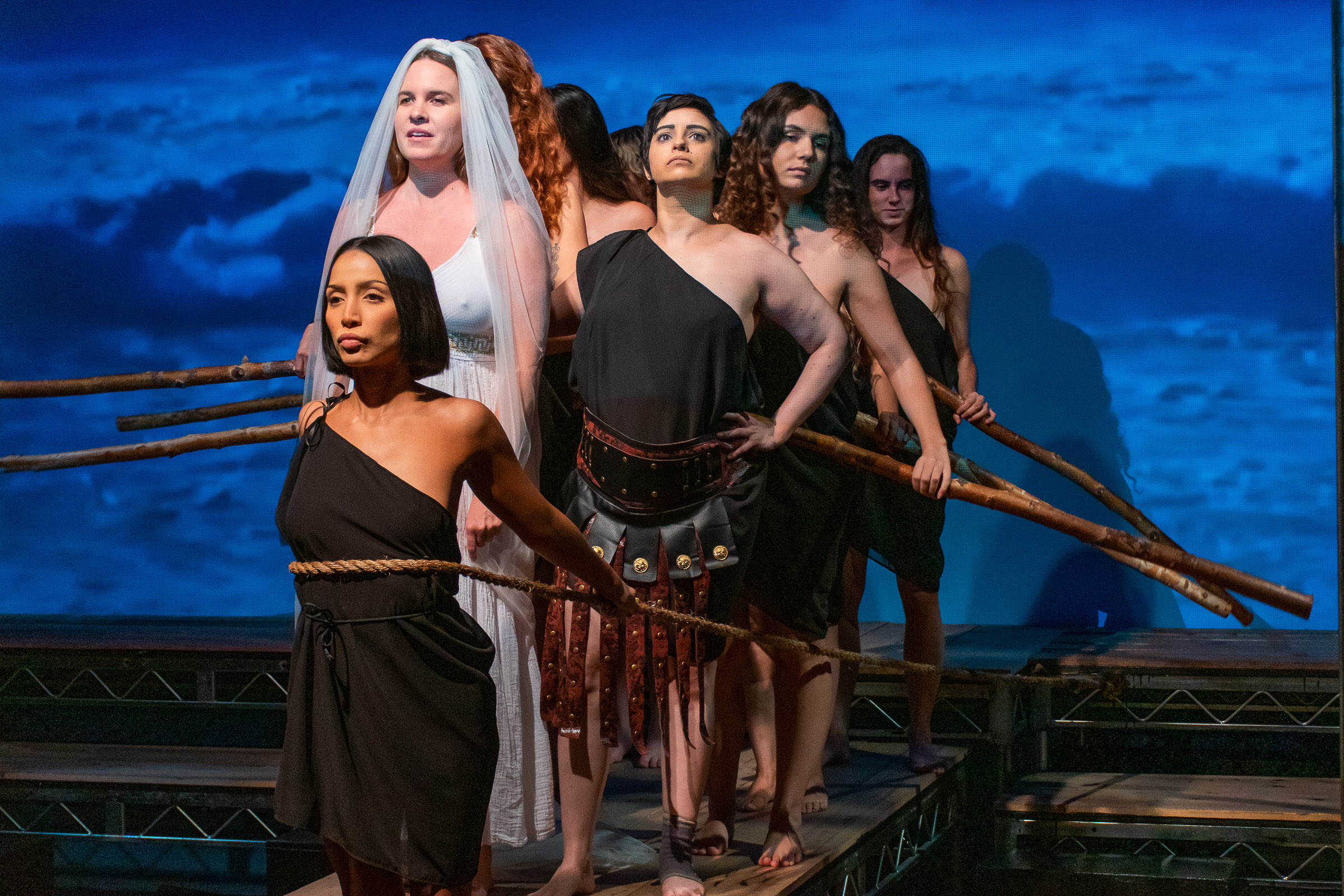
Happily, time has passed and CityGarage survived, and now they have resumed their plans to produce this play, which tells the story of the Odyssey from the point of view of Penelope, wife of Odysseus.

We begin in Hades, the afterlife, when the shade of Penelope (Peggy Flood) ponders her life and its consequences,  She recalls her youth (Lindsay Plake) and how her father almost had her drowned due to an oracle.  However, Penelope's mother (Angela Beyer) was a sea nymph and the children of such do not easily drown.  She also gives her child some advice that will help and hurt her in the years to come, about being water which does not resist but envelopes, goes around, and in the end always wins.

Metaphors and similes being inexact, this proves of mixed value.  Penelope later ends up wedded to the clever Prince of far away Ithaca (Emily Asher Kellis) who--like every other royal in the Bronze Age--had vied for the hand of Penelope's beautiful, remorseless cousin Helen (Marie Paquim), and whose unfaithfulness would later spark a war.  The bulk of Penelope's story takes place in Ithaca, where initially she has little to do save bear a child, Telemachus (Courtney Brechemin).  In particular she has to deal with Eurycleia (Geraldine Fuentes), her husband's old Nurse who spoiled him, and then spoils his son, with the careless and relentless will of someone only a little clever but not at all wise.

The real challenges arise, however, as the Trojan War proceeds, then ends, but Odysseus does not return for ten long years.  Having done much to make Ithaca wealthy, Penelope finds herself the target of predatory suitors (Kat Johnston, Devin Davis-Lorton, Mary Egan) with only the help of a dozen special maids, slaves born on Ithaca and who had become dear to her (Loosema Hakverdian, Marissa Ruiz, Lea De Carmo).  From such comes the tragedy to unfold, for the Maids haunt Penelope in Hades. Eventually we learn why.

So much for plot.  What really makes up the beating heart of this production are the twin beats of ritual and theme.  In a true echo of Greece's ancient theatre, much here is made of dance and masks, with the Maids switching between individuals enduring assault and hatred and a final blinding cruelty, and also a true Greek Chorus bidding us consider the world from the viewpoint of the less fortunate, the abused, the so-called "walk ons" and "extras" in life.  This includes, of course, all women, to one extent or another.  While a feminist work, this play seems mostly to focus on the more pervasive sins of Vanity and especially Cruelty.  Indeed, Penelope at one point notes how she has watched the world in the millennia since she died.  It has only grown worse, in her eyes.  That is why she refuses to re-incarnate, to re-enter that cruelty, even though she remains tortured by her husband's charm which covers up his restlessness.  Worse, she remains haunted by the shrill voices/images of her "doves" the murdered Maids she failed to protect.

Yes, it was not her fault.  She tried.  But she did fail.  And more to the point, she should never have had to try.  But this world is full of casual cruelty.  Better to remain in Hades.  That was what Penelope learned.  Water does not conquer in the end.  Water simply remains.  It does not seem enough.

But also, the ritual which which the play appears before us demands some praise.  In fact nearly the entire cast plays multiple roles, and sometimes I barely realized some played certain roles until I read the program.  The way the cast members became ships, became waves, became ghosts, became slaughtered animals, etc. was part of how director Frederique Michel brought a frankly difficult play to life.  It proves a wonderful dive into the imagination, rather than some over-extravagant outpouring into live special effects on stage (I'm looking at you Phantom of the Opera as well as a dozen others).  When certain things happened on stage in this production, I flinched.  Other times I giggled, usually with at least one character.  This show despite its scale of wars and worlds, remained intimate not only in terms of the writing but our experience.

The Penelopiad plays Fridays and Saturdays at 8pm, Sundays at 4pm until December 18, 2022 at CityGarage, Bergamont Station, 2525 Michigan Avenue, Building T1, Santa Monica CA 90404.  

Monday, March 14, 2016

Cloud 9 (review)

Spoilers ahoy!

Caryl Churchill's Cloud 9 remains my favorite English language play of the 20th Century, so you can imagine how I reacted to news the Antaeus Company would be mounting a production of same.  The play makes for delightfully weird mirror of both our modern world and the Victorian Era out of which it arose.  Specifically, it deals with sex--not only in terms of sexuality (explored in a somewhat dizzying array) but more fundamentally in terms of gender as well as the troublesome/delightful fact sex even exists.

We begin in Africa, 1880, with an English family--Clive, his wife Betty, their daughter Vicky and son Edward--living on an estate, proudly striving to do their duty and save the natives from their savage natures.  Act Two picks up with exactly this same family precisely ten years later--in London 1980.

Yeah, ten years and simultaneously one century later.  Don't try and understand it, just go with the flow.

The layers in this play seem nearly infinite, to those of us lucky enough to have seen multiple productions of it, with each one revealing new insights into the situation, the characters, the ideas.  Obviously, it hardly qualifies as "realism" but like dream or myth it is all about Truth.  Not the easy truths, the comfortable truths, but the complex ones, the truths that challenge wrong (but extremely common) assumptions down to bedrock, and doesn't offer any kind of a neat solution to problems raised.  Maybe that's one reason it is remains so funny.  If it weren't the resulting disorientation might prove too much.  Then again, the humor is part of the challenge, a vital part of the experience.

In a nutshell, for Act One we get an almost Monty Python-esque pastiche of the Victorian Era, including the fact wife and mother Betty (Bill Brochtrup) is played by a man.  "I am a man's creation," she says, "and what a man wants is what I want to be."  Likewise their son Eddy (Deborah Puette) is played by a woman, while the daughter is portrayed exactly the way we might imagine such a household sees a baby girl--a doll. Well, of course.  Just as the black manservant Joshua (Chad Borden) is white.  "What white man wants is what I long to be."

 Then the homosexuals show up, in the person of the explorer Harry (David DeSantos) and Vicky's governess (Abigail Marks).  Hilarity, some of it very dark, ensues.

Act Two on the other shows what Britain has become in the next century, roughly contemporary to ourselves (one could assume the two acts take place in 1915 and 2015 without much of a stretch).  And while almost everything has in some sense returned to what we think of as normal--men playing men, women playing women--we're still left with the disorienting thought this involves many of the same individuals.

However, the five year old bratty girl is played by a middle aged man.  Just to help remind us of possibilities, and to offer comment (such as how very much she loves to play with guns).

But more than that--and here are very much in real spoiler territory--the stylization of all this makes for a ritual every bit as religious as Holy Communion. Or is that "mystical"?  Grown up Eddy and his sister Vic  each have relationship problems, then end up flabbergasted when their middle aged mother Betty leaves their father.  Vic meanwhile begins a relationship with Lin, the mother of the aforementioned bratty little girl.  A moment of contemplation between the siblings leads to a new arrangements--a bisexual incestuous triangle, sans jealousy but full of love.  And then...it happens.

The three of them get drunk one night, and decide to have a ritual, an attempt to call up the Goddess of the most ancient times, she of many names who has been forgotten but is now again appearing in human memory.  And they offer up that most brave and wonderful of prayers--Give Us What We Need!

What follows is a change in time and space, a series of genuine miracles that nudge all to where (in time) they each might come to be.  Where?  Cloud 9 of course.  For now, as the play ends, only one of them seems to make it, but they all might be heading there.  We end with hope.

Especially the closing moments of the play, oh that most splendid of tear-jerking moments, when the middle aged Betty remembers her mother and her husband, how they defined her.  And the sweet pleasure of discovering she herself is real.  More, she is free.  Then she turns around to see...herself.  From Act One.

Not going to tell you what happens next.  See it for yourself. One amazing quality of this play is just how much every single production leads me to new insights, not simply in terms of my mind but in the gut.  At least if the cast is good enough, and this one proves very good.  Every character comes to life, and even the ones most appalling ultimately come across as very human, which in this context means lost and confused, trying to find their way to Cloud 9.

I'll also say this production handled the songs extremely well, turning them into simple but quite effective little musical numbers.  Yeah, the play is a musical.  Kinda/sorta.  A little bit of one anyway.

Cloud 9 plays Thursdays, Fridays and Saturdays at 8pm as well as Saturdays and Sundays at 2pm until April 24, 2016 at the Antaeus Theatre Company, 5112 Lankershim Blvd (south of Magnolia) North Hollywood CA 91601.

NOTE:   This production has two complete casts who rotate in repertory.  I saw the play as done by  The Blighters but the other cast are The Hotheads.  I presume they are equal in quality to their fellows.


Wednesday, October 14, 2009

Manhood and Science Fiction

I only recently became aware of this debate going on, pretty much captured in The War on Science Fiction and Marvin Minsky, a blog entry that also writes glowingly of Dirk Benedict's essay Lt. Starbuck...Lost in Castration. Essentially, both are complaining (and using the re-imagined Battlestar Galactica as a prime example) that science fiction is becoming less masculine and more female-oriented. Interestingly, this is regarded as a "bad thing".

Frankly, I have trouble taking Mr. Benedict very seriously when it comes to understanding what makes a good story. In the 1980s he performed the lead in Hamlet in NYC, and I had the...experience...of seeing that show as well as reading his disparaging comments about other productions. His costume rather resembled that of Flash Gordon, and his delivery indicated no hint of what people like Laurence Olivier, Richard Burton, Kenneth Branaugh and Kevin Kline (my personal favorite) saw in the role or the script. The sword fight was great, though. And (not coincidentally, I think) the Ghost was done as a special effect, with lights shining around the theatre and a voice booming from the sound system.

But I digress. Both writers make what seems like a very curious set of arguments -- about gender roles, about science fiction and about story-telling in general. Please feel free to read them via the above links, but in a nutshell here seem to be their main points:
  • To be truly masculine in a desirable way, men must be macho. What this apparently entails is stereotypical stuff like womanizing, unbending emotional self-control (save maybe in the case of righteous rage), and a taste for violence.
  • It is for some reason bad or undesirable for women to be in positions of authority, most especially if they are giving orders to men.
  • Homosexuality really shouldn't be a subject matter in science fiction, nor should the blurring of sexual roles.
  • All of the above is indicative of an anti-male bias (Question--is the opposite an anti-female bias?) to be judged harshly as such.
  • Science fiction, by becoming in some sense "feminized" has also turned against hope and all things positive in favor of a voyeuristic delight in negativity.
No one should be too surprised to read I question pretty much all of the above premises. A lot.

One level it is really too easy to tear apart these ideas. For example, any viewer of the new BSG would be hard-pressed to call Commander Adama anything but a very strong man in pretty much every single way. But I'm more concerned with two specific ideas that run like currents in both the above posts.

Let us deal with the more hidden idea. My own experience and study has led me to believe most people who give any thoughts to art tend to see its purpose in one of two ways. J.R.R.Tolkien spoke of such when he wrote of preferring "history" to "allegory", a remark many have used with which to compare Lord of the Rings with the works of his friend C.S.Lewis The Chronicles of Narnia. My own preference is to compare Shakespeare with his contemporary Johnson on this matter. For lack of better terms, I call one the Givers of Answers and the other the Askers of Questions. Another way (perhaps more accurate) is to note one approach is to view art as propaganda, the other seeing it as an experience. One poses questions only to feed you the answer. The other poses questions but gives responsibility for finding the answer in your own hands.

Good fiction needn't belong to only one of these two schools. The storyteller can even be a little heavy-handed and achieve considerable quality. Case in point (and returning to science fiction), Blade Runner. The story posits a terrible injustice (not coincidentally, at least IMHO, one similar to the very heart of the new Galactica), namely that mankind has created synthetic people -- with feelings, thoughts, free will -- and made of them slaves. Ultimately, there is little ambiguity here. The Replicants (as they're called) are victims of an insidious evil. Even if you consider every violent act they commit totally unjustified, it takes someone strangely dense not to see them as wronged (the only person I've ever met who didn't "get" that was an engineer -- make of that what you will). Decker, the title character, is a murderer many times over. What makes the story so compelling (apart from fine acting, a dizzying production design, etc.) is that we see him learn better. It is the story of a leopard who changes his spots, not in a remotely saccharine manner (he doesn't let a bunch of dangerous and violent Replicants simply get away) but by falling in love with one. The Director's Cut underscores this even more.

Now, examine the same idea but without taking it seriously. In Star Wars two of the most popular characters are R2D2 and his golden companion C3PO. Yet how much is made of the fact that both of them are exactly as much slaves as the Replicants? Both film trilogies are supposed to be epic struggles to defend/restore freedom to the galaxy -- yet not for droids. Machines don't count, no matter how kind or intelligent or even loved. It doesn't even occur to anyone in any of the six films that mechanical life should perhaps have a choice -- not even to the machines themselves.

Those who want to see simple morals in their stories too often end up demanding simplistic ones. In efforts to find ethical answers, they cheat on the test. One can go at great length (and many have) about the weird moral implications given by George Lucas -- and such is justified due to his explicit efforts to present a fable. It comprises a major, oft-repeated criticism of the films. I've read published books on the subject. Critics of Blade Runner, on the other hand, often complain about some of the very things which defined the re-imagined Galactica. It is too dark. The hero doesn't have clean hands. It it depressing. The end doesn't see what is wrong with the world corrected.

Here is my take. Those complaints are about the real world. Life is breathtaking in its beauty, and mind-bogglingly horrible in its ugliness. Not one or the other. Both. Individual people contain wisdom and stupidity, compassion and cruelty, bravery and cowardice. Want a story that involves us on many levels? Capture that dichotomy. Take an idea, and explore it seriously. Yeah, make it a ripping yarn but remember every video store in the world is full of formulaic action films that couldn't sell tickets.

The Boy Who Cried Wolf is a simple, easy-to-comprehend tale with an important lesson. Aesop remains a classic precisely because he knew how to tell a fable well. But no one equates Aesop with Sophocles. It isn't somehow manly to act like the world is a video game. It is only boyish -- embarassing to see in a grown man. Boys think everything can be fixed with right gizmo, that girls are yucky, that an explosion equals excitement and that tears are something of which to be ashamed. Men have grown beyond all that -- and as a result, do far more good and experience far more joys than boys ever can.

Boys also whine when they don't get what they want. Let us be fair -- so do girls. Men and women learn better.

Revisiting childhood can be loads of fun. The journey and vacation can be therapeutic. Living there full-time is a tragedy. Even for Flash Gordon or Luke Skywalker.

Or Lieutenant Starbuck.